
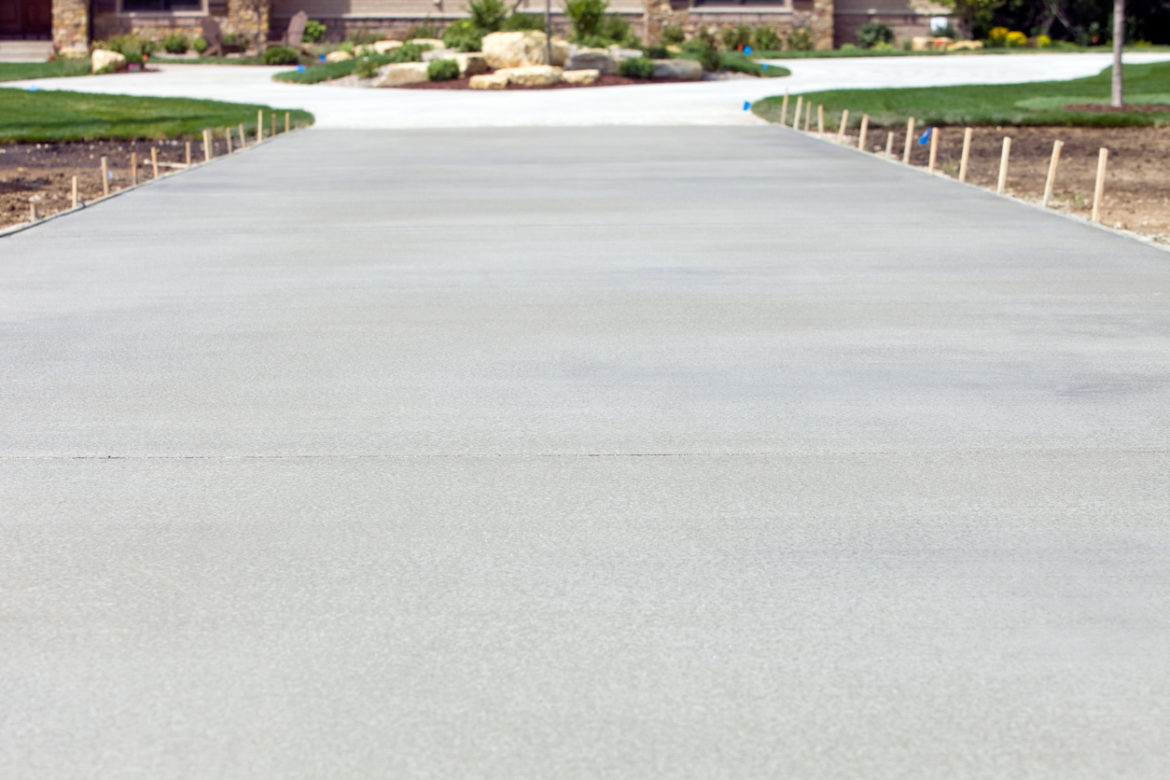
$8000 to $10,000 is the average cost to replace a concrete driveway. By using a concrete sealer on the driveway at time of installation you are essentially ensuring that you will not have to replace your concrete driveway after years of harsh deicing salt chemical usage, chlorides and freeze-thaw damage. When looking for a concrete driveway sealer the sealer you choose will depend on a variety of factors including concrete type, geographical location, and desired finish.
Concrete Type:
Stamped concrete – If you are looking to seal stamped concrete you are typically looking to enhance the colors and textures with a matte, satin or glossy finish. For this we would recommend looking for an acrylic based sealer or a silicone based sealer. Acrylics are available in either solvent based or water based varieties; water based acrylic sealers typically leave a satin finish whereas solvent based acrylic sealers typically leave a gloss finish.
Concrete – If you are looking to seal a concrete driveway you are really going to want to take into account your geographical location. If you are located in an area where deicing salts are used you are going to want to use a silane or silane/siloxane blend. If you are in a warmer climate where there are no freeze-thaw cycles and deicing salts are not used on the roadways you have a few more options. Silane/siloxane sealers are always excellent choices but are more expensive than other siliconate and acrylic based products. If you are looking for an economical options look for a concentrated silicate/siliconate blend and if you are looking for a decorative finish use an acrylic based product.
Pavers – Depending on the type of finish you are interested in you can use a silane/siloxane, acrylic or silicate/siliconate blend. If you are looking for a natural finish and/or if you are looking for deicing salt protection use a silane/siloxane product, if you are looking for a satin or high gloss finish use a water based or solvent based acrylic, and if you are looking for a natural finish and the most economical option use a silicate/siliconate blend.
Brick – Brick driveways are best sealed using a silane/siloxane blend. Because of the breathability of these sealers they will protect the bricks without any yellowing, flaking or peeling and the sealer will protect the bricks from efflorescence attacks.
Concrete driveways are susceptible to numerous problems if not sealed and left untreated. During the winter deicing salts and chlorides are used to treat roadways and bridges throughout the country. Vehicles unknowingly and knowing then track these salts into the driveway and over time the concrete begins to spall, pit and crack. By using a penetrating water repellent sealer water is kept out and all of the deleterious substances being tracked into the driveway are also kept out of the concrete. A penetrating silane/siloxane blend is the best type of sealer to use on a new or existing driveway because it is able to repel water, salts, chlorides and some even repel oil and automobile fluids like the Invisible Penetrating Concrete and Masonry Water Repellent Sealer Plus Oil Repellent. The upfront cost of sealing a driveway may initially seem steep but when compared to the price of resurfacing or replacing a driveway it is actually a small price to pay for a well protected and sealed driveway. Most silane/siloxane blended sealers leave natural finishes so they will not change or alter the appearance of the driveway. If you are not looking for an oil repellent sealer the Siloxa-Tek 8500 product is an excellent choice for deicing salt and waterproofing protection surpassing the National Cooperative Highway Research Program’s (NCHRP 244 Series II & IV) water absorption and chloride intrusion tests.
With the constant exposure to the elements, from rain, snow, salt and sun, driveways are continuously exposed and susceptible to damage. When looking for a concrete driveway sealer it is best to keep in mind where you live will effect the sealer you want to apply. If you live in the north, with snow and salt degradation major issues you want to look for a silane/siloxane blend sealer. Extremely durable solutions frequently used on municipality jobs, silane/siloxanes will help to prevent freeze-thaw damage and salt degradation. The higher percentage of solids of silane/siloxane the better the protection and the heftier the price. Make sure when purchasing a silane/siloxane you inquire about the percentage of solids and do not even bother with a less than 20% solids silane/siloxane.
If you are fortunate enough to live in a warmer climate where snow and salt degradation are not threats to your driveway and if your driveway is comprised of pavers or brick your best bet would be to use a high quality acrylic sealer. If you are looking for a decorative high gloss finish look for a solvent based variation and if you are looking for a matte finish look for a water based sealer. Make sure the acrylic is hot tire pickup resistant, non-yellowing and UV stable.
Our Take: Concrete Driveway sealers we like are Okon S-20 and Siloxa-Tek 8500 they are long lasting with a high percentage of solids.
Concrete driveways, extremely prominent in southern areas of the country, need to be sealed in order to protect them from sun, rain, weathering and other exterior elements. Driveways and sidewalks are susceptible to wear on a daily basis from foot traffic and automobile traffic. In order to protect your driveway you need to use an industrial grade concrete driveway sealer.
With the multitude of sealers on the market how do you choose the best sealer for a driveway? When looking for a concrete driveway sealer look for a silane/siloxane blended sealer. By using a silane/siloxane you get the benefits of a penetrating and a topical sealer all-in-one. Other benefits of using a silane/siloxane on a driveway include the prevention of mold, mildew, efflorescence, sun, wind driven rain, salt degradation and hydrostatic pressure. You will literally be able to see the sealer working before your eyes; silane/siloxanes are known for their beading of water.
Silane/Siloxanes are extremely popular sealers sold from everywhere from local hardware stores, big box retail chains and online. Make sure to look for a silane/siloxane that will protect from salt, chlorides, freeze-thaw damage and water.
Our Take: Top driveway sealers are Siloxa-Tek 8500 and Okon S-40.
If you live in an area with a warmer climate, such as in the West or the South, then there is a strong possibility that your driveway will be made from concrete. Concrete driveways also appear in colder climates, though asphalt tends to be the preferred method of construction, as it holds up to colder seasons better than traditional concrete.
Either way, wherever your home is located, having a concrete driveway means you are at risk for the various problems that can plague exterior concrete. Concrete, while strong and long-lasting, can suffer from cracking, spalling, crumbling, and a general degradation over time with prolonged exposure to the elements. As concrete is dotted with tiny pores all across its surface, these pores can allow water, salts, and other debris to enter to the concrete’s microscopic network of pores and hairline cracks. The incursion of water, salts, and such can be disastrous for the concrete driveway, as the concrete can degrade over time from within.
Fortunately, there is an easy solution to prevent the degradation of your concrete driveway. Whether you live in a warmer or colder climate, you will want to use an acrylic sealer on your delicate pavered driveway. Pavers are a type of concrete with larger pores that is, accordingly, more porous. The increased porosity of the concrete makes penetrating sealers a bad option for protecting the surface from degradation. Therefore, the best option remaining is a surface sealer, like an acrylic.
You will likely want to choose an acrylic sealer that is a water-based solution, as these are easier to apply while also being safer for yourself, your family, and the environment. These sealers are full of large particles of acrylic sealant that pool on the surface of the concrete driveway to be spread out evenly over the course of the application. Once spread out properly, the sealer will provide comprehensive surface-level protection.
Our Take: The top acrylic sealers for exterior driveways are Cryli-Tek 5500 and Everclear