
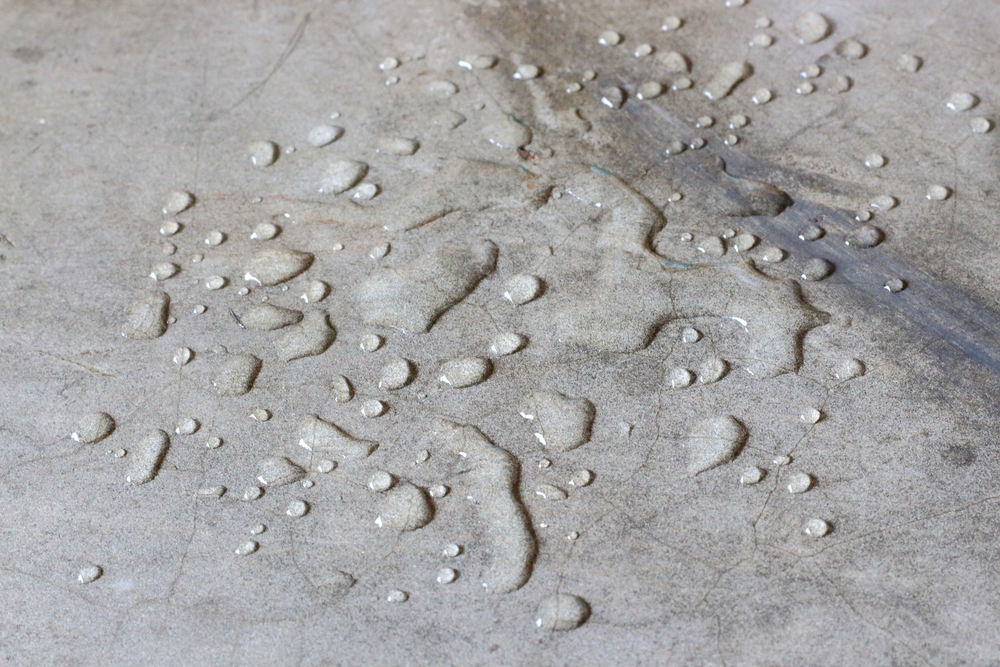
While many concrete sealers claim to offer protection from water damage, most only offer some degree of water resistance. If you are looking for a true water repellent sealer, for instance, an acrylic will not really give you the protection you have in mind. Water repellent sealers are different from penetrating sealers because they are surface sealers. A good example to picture the protection offered by a water repellent would be that they act like a raincoat does. When applied to the concrete, the water visibly beads before sliding off, keeping the concrete dry underneath.
Just like penetrating sealers, water repellent sealers are appropriate for certain types of projects. A delicate piece of concrete cannot be treated with a concrete densifier or any other type of penetrating concrete sealer. Instead, a water repellent sealer is more appropriate, as these types of sealers feature large particles of sealant that cannot penetrate past the tiny surface pores natural to concrete. In order to ensure the concrete sealer is applied properly, you just need to pour out the sealer onto the concrete before spreading it out across the surface of the material.
If you are looking for a sealer that repels water, your best choice would be a silane/siloxane type of sealer. Be sure to look for a water-based variety that offers comparable levels of protection to solvent-based counterparts. Silane/siloxane sealers are made up of a blend of penetrating silane particles combined with surface-level siloxane particles. These two types of particles of chemical sealant function in concert to create a hydrophobic barrier that will block out water and excessive moisture from entering the concrete. The two types of sealant particles ensure that the surface of the concrete retains the most thorough possible protection, while the concrete itself is also protected in case any water seeps through the primary surface level of protection.
Our Take: Water repellents we recommend are Okon S-40 or Siloxa-Tek 8500
The Solid Color Concrete Stain manufactured by Valspar is marketed as a concrete staining product that will also seal your concrete, offering an increased level of protection. However, this is not entirely true. The Solid Color Concrete Stain is more of a paint than a concrete sealer; as such, it will not truly protect your concrete from potential sources of damage ranging from water damage to cracking and general degradation.
The Solid Color Concrete Stain is an acrylic resin, which means it would be, at best, a surface level sealer that would bond to the concrete substrate. Through bonding, it would, ideally, offer a level of protection from water and UV rays from the sun. However, its chemical composition reveals that it is a weak product that will not really protect your concrete for any significant duration of time.
It will, however, give color to your concrete. The Solid Color Concrete Stain is a product very similar to paint than a true concrete stain. Instead of seeping into the concrete to change the color of the concrete in a lasting manner, it will be applied over the concrete. This may lead to a stronger level of color, but it is also vulnerable to chipping and other types of aesthetic damage over time. If you want a true concrete stain for your project, the Solid Color Concrete Stain will work, though it is not the best choice. And if you want a sealer to protect your newly stained concrete, the Solid Color Concrete Sealer will not work in the way you want it to.
The Polyseal Plus is a concrete sealing product manufactured by ChemMasters. The product itself is an aliphatic urethane product featuring a high solids content. This means the product performs very well, though it also dangerous and potentially harmful, for both you and the environment. Be sure to check with your state’s environmental regulations, as the Polyseal Plus features a high VOC content, which is regulated by at least sixteen different states.
The Polyseal Plus is an aliphatic urethane. Aliphatic urethanes are high quality products that are surface level sealers. The Polyseal Plus will, once applied, adhere to the surface of the concrete substrate given proper application techniques. Urethanes are extremely durable, and the Polyseal Plus offers extreme weathering and abrasion resistance, like all other urethanes, all while guaranteeing color stability and non-yellow UV protection from the sun’s potentially harmful rays. Furthermore, the Polyseal Plus can be appled to decorative concrete, as well as the stronger stuff, making it a versatile product – however, if you have a product specifically calling for a sealer that works primarily with decorative concrete, you’re better off choosing a more specified concrete sealer.
The final consideration with the Polyseal Plus is its strong odor and fumes upon application. Make sure you are in a well ventilated area when applying the Polyseal Plus, as the urethane’s fumes can be potentially hazardous to your lungs. That being said, the Polyseal Plus is no more dangerous than most other solvent-based sealers, so these are just natural and necessary precautions.
When you have concrete, and you know that you have to seal it with a concrete sealer, the next step is figuring out which sealer to purchase. Once you have done all of your research and purchased a sealer that shipped to your home – no problems – you are now ready to start the application process. If you ready all of your materials, clean the concrete, acid etch the surface, and wait the requisite amount of time, you just have one more thing to make sure of: the temperature.
Concrete sealer is a chemical mixture that contains particles of chemical sealant suspended in either water or a chemical solvent. Either way, the sealers have to be stored and applied at certain temperatures to be at their most effective. To begin with storage, concrete sealers should not be stored frozen, nor should they ever be at risk of freezing. A frozen concrete sealer will feature less effective particles of chemical sealant, rendering if significantly less effective when it actually is applied (though you may not be able to tell the difference). As many concrete sealers are water-based, which are undoubtedly better concrete sealing options, they are also at risk for freezing (you still should not allow a solvent-based product to freeze either, though it will be more difficult to make happen).
Similarly, there are some general temperature guidelines to keep in mind when applying the concrete sealer to the concrete slab as well. First off, the surface of the concrete and the environment of the room in which the concrete sealer is being applied should not dip below around 50 degrees Fahrenheit. Below 50 degrees Fahrenheit, the concrete is too cold to allow the concrete sealer to penetrate or bond to the surface effectively, depending on which type of sealer you are using. The concrete and the room in which it is being applied should not exceed approximately 90 degrees Fahrenheit either, nor should it be applied in direct sunlight. If you find yourself with a surface that is too hot, wait for a cooler day or wait until nightfall. Similarly, if you have a surface that is too cold, try using a space heater to heat up the (for example) basement to a more agreeable temperature before applying the concrete sealer. While this may some extra effort, the concrete sealer will penetrate or adhere better, which is better for the concrete in the long run.
With all of the concrete sealing product options on the market today, the oft-grandiose claims of many manufacturers and distributors can dupe many unsuspecting customers. The proliferation of the Internet has not helped matters, as a company can say almost whatever they want online without fear of great repercussions. One of the perennial claims made by most manufacturers and distributors is that concrete sealers and concrete densifers can actually fully waterproof concrete.
Waterproofing concrete is one of those benefits that everybody wants. The idea of making your home or building impervious to water damage is almost intoxicating in its desirability. However, for the vast majority of products, these claims are utterly bogus. While most products claim to offer complete waterproofing, they really only offer water resistance, at best. Some do not even offer any protection from water at all. How is the consumer unversed in concrete and concrete sealing to know which products are reliable and which are not?
Silicate densifier formulas have been around since the 1950′s and were initially used as concrete floor hardeners. Today because of their economical nature many concrete manufacturers and distributors claim silicates to be effective waterproofers. Silicate solutions have a place as a concrete treatment; however, their role should only be limited as concrete surface hardeners. Silicate solutions perform very poorly and ineffective as waterproofing sealers since they have a limited depth of penetration and they are unable to stop or reduce hydrostatic pressure. If you want to densify your concrete a Silicate hardener is an excellent option; however, leave the waterproofing to another product.
Our Take: Straight silicate densifiers cannot waterproof concrete; however, we reviewed the # 1 concrete waterproofer in this article.